TL;DR (Too Long; Didn’t Read)
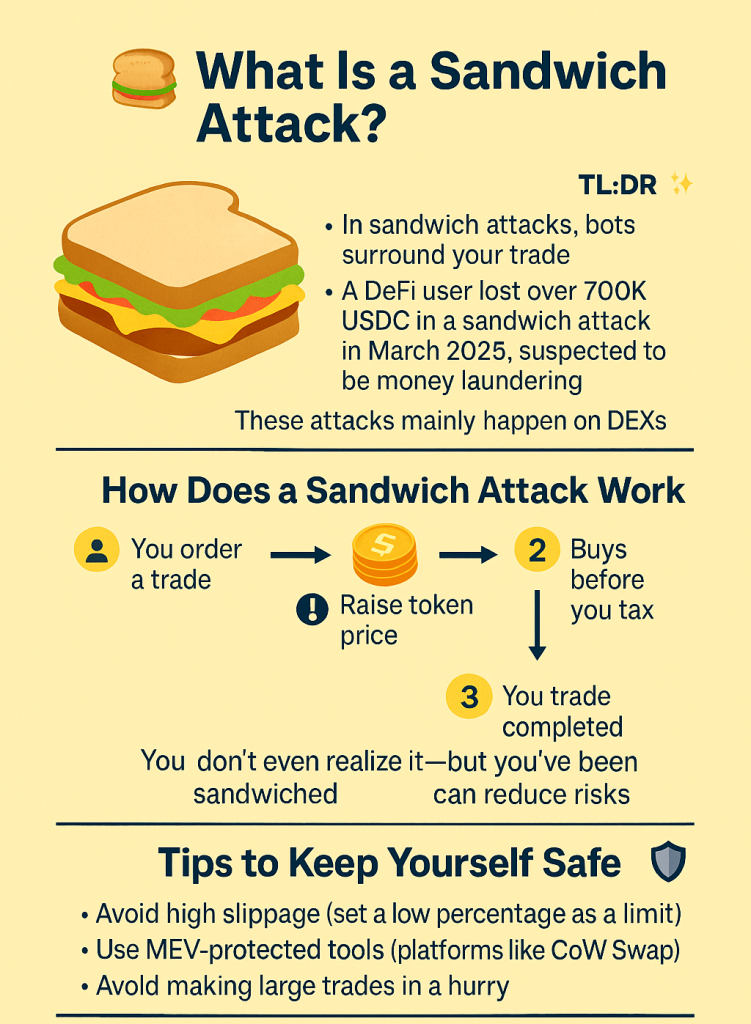
- Sandwich attacks happen when a bot sees your trade coming, and it quickly places a buy order before you and a sell order after you.
- It “sandwiches” your trade and profits from the price bump your trade causes.
- A DeFi user lost $700K+ in USDC to a sandwich attack in March 2025. Some experts even suspect it might’ve been money laundering.
- These attacks mostly happen on decentralized exchanges (DEXs) like Uniswap.
- Use slippage limits, private transactions, or MEV-resistant protocols to reduce the risk.
What is a Sandwich Attack?
Imagine you go to a food stall and say, “I want to buy a sandwich for $5.” Someone overhears you, quickly buys the same sandwich for $5, then turns around and offers it back to you for $6. You’re forced to buy it—now it costs more, and they make $1 profit.
That’s what happens in DeFi sandwich attacks, but instead of sandwiches, it’s crypto tokens—and bots, not people, do the trick.
How Does a Sandwich Attack Work?
- You submit a trade on a DEX like Uniswap.
- A bot spots your trade before it’s confirmed (this is called MEV – Miner/Maximal Extractable Value).
- The bot places a buy order just before yours (front-run).
- Your trade goes through, which moves the token price up.
- The bot then sells right after you at a profit (back-run).
- You get your trade, but at a worse price than expected.
You might not even realize it—but you just got sandwiched.
Real-World Case Study: $700,000 USDC Lost in a Sandwich Attack
- A DeFi user made a huge swap of 1.8 million USDC for wrapped Ether (wETH).
- A bot spotted the trade and sandwiched it.
- Result? The user lost $700,000+ in slippage and bad pricing.
- The attacker earned around $1.38 million.
- Experts suspect the possibility of self-sandwiching to convert blacklisted funds into clean tokens (aka money laundering).
How to Protect Yourself
- Avoid high slippage — Set slippage tolerance to a low percentage (like 0.1–0.5%).
- Use MEV-protected tools — Platforms like CoW Swap, Flashbots, or private RPCs can hide your transaction until it’s included in a block.
- Don’t rush big trades — Break them into smaller chunks or use limit orders.
- Use wallets and tools that simulate trades and warn you of MEV risks.
Sandwich Attack for Dummies
What’s Happening?
Imagine you say:
“I’m going to buy 10 ice creams!”
Then a sneaky kid runs ahead, buys all the ice cream, and when you reach the counter, he sells them back to you at double the price.
You still get your ice cream… but now you paid more and he got free money. Not fair, right?
That’s a sandwich attack in crypto!
- The first buy is the top bread
- Your trade is the filling
- The second sell is the bottom bread
That’s why it’s called a sandwich.
Why Should I Care?
Because even small trades can be targeted. And if you’re doing large swaps, you could lose thousands without even knowing. Sandwich bots are fast, invisible, and legal in many cases.
Final Thoughts
Sandwich attacks are part of the darker side of DeFi. While they aren’t technically hacks, they exploit your transaction using advanced bot logic. It’s like front-row finance warfare between bots and users. This is another form of scam which we see in the crypto world.
By understanding how they work and taking simple precautions, you can stay safe, avoid being “the cheese in the sandwich,” and keep more crypto in your pocket. Share your story if any on our socials.