
A Member asked in a monthly Q&A “Why all blockchains differ in gas fees?, Some offer very low gas fees and some too high“. Let’s expand on that questions explaining why some blockchain has higher network fee while some have lower. Will try to explain in easy terms along with a technical explanation.
Layman Explanation
“Why Do Gas Fees Differ? Think Like Uber”
Imagine using Uber during different times of the day:
- At night or off-peak hours, rides are cheap and instant.
- But during a rainy rush hour, demand surges—Uber charges more (surge pricing) and it may take longer.
Blockchains work the same way:
- When lots of people are using a blockchain at once (like Ethereum), the network gets congested, and you have to pay more to get your transaction confirmed faster.
- On less busy or faster networks (like Solana, Polygon), you get your ride (transaction) quickly and cheaply—no surge pricing.
It’s not that one is always better—some are faster and cheaper, others are more secure and trusted, but a bit pricey.
Technical Explanation
“Network Design, Demand, and Fee Mechanics”
Gas fees differ due to:
- Throughput Capacity:
- Ethereum has ~15–30 TPS; Solana hits ~65,000 TPS. More capacity = lower congestion, hence lower fees.
- Fee Model:
- Ethereum uses a base + tip (EIP-1559) model that fluctuates based on traffic.
- Solana and many Layer-2s often have low fixed fees or nearly-free microtransactions.
- Block Space Economics:
- Each block has limited room. When more users compete to get in, fees rise due to demand-pressure.
- Architecture & Consensus:
- Ethereum prioritizes decentralization and security—at the cost of scalability.
- Chains like Solana or BSC sacrifice some decentralization for speed and affordability.
So, like Uber during a cricket final in Lahore vs. a random Tuesday night—same app, wildly different prices.
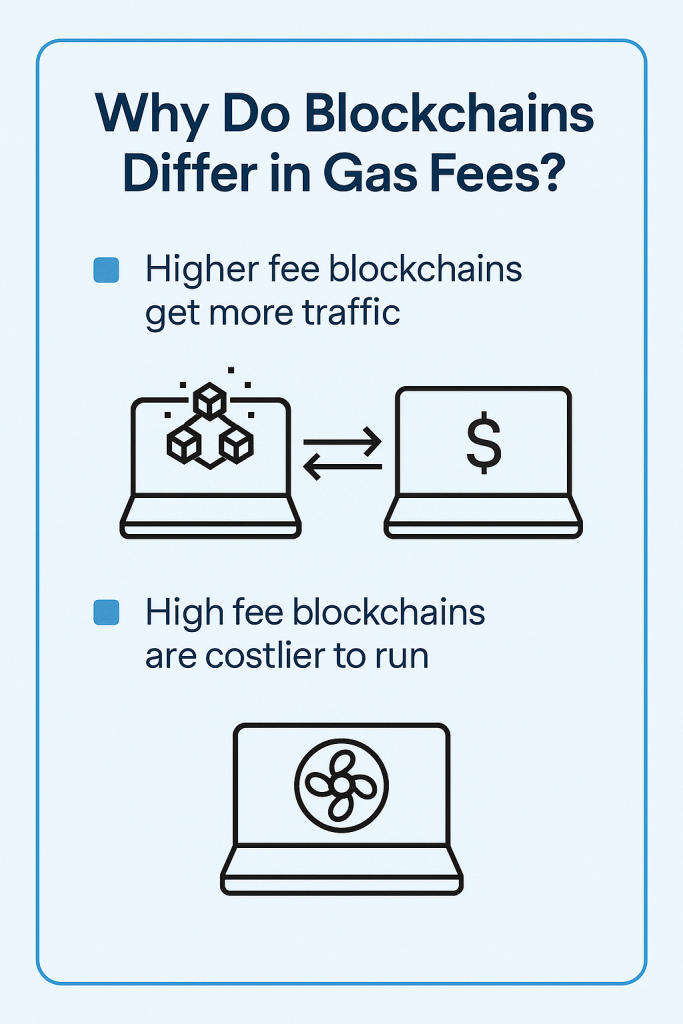
What you just read above might hint towards more usage = higher fee, that may not be entirely true, let’s discuss.
High Gas Fees ≠ Just High Usage
(But Often Related)
Yes, popular blockchains like Ethereum often have high fees because so many people are using them at once, and block space is limited. It’s like everyone trying to board the same train—you end up paying more to get on.
- More demand = more competition = higher fees (just like Uber surge pricing).
- But usage alone isn’t the full story…
Designed to Be Expensive
Blockchains like Ethereum have:
- Highly decentralized validator networks (harder to run, more secure).
- Smaller block sizes to ensure everyone can run a node.
- Longer processing times (more checks = more security).
This architecture increases operational cost and limits scalability, leading to higher gas fees even if demand isn’t extreme.
Designed to Be Cheap
Chains like Solana, Polygon, BSC are:
- Optimized for speed and throughput.
- More centralized or less resource-intensive.
- Have lower validator requirements, so running costs are cheaper.
They can process more transactions at once, so users don’t need to compete with high fees to get included in a block.
TL;DR
- High fees can mean high demand, but also reflect expensive architecture (security, decentralization).
- Low fees often mean scalable design, cheaper infrastructure, or less decentralization.
So yes, both usage and running cost design affect fees—but they aren’t always tied 1:1.
Let us know if you want some other query added in the FAQs by getting in touch through our socials.